When you buy through links on our articles, Future and its syndication partners may earn a commission.

You may not have heard of "noctourism" before. I'll be honest, neither had I until very recently. The term refers to travel that's deliberately planned around nocturnal experiences; after-dark adventures that most visitors never see. The trend grew by 25% in 2024 and is projected to be worth $20 million by 2035.
With TikTok searches for 'night safari Africa' up 57% in the past year, interest is clearly building. And for photographers, the appeal is obvious. An entirely different cast of subjects, lighting conditions found nowhere else, and frames that no daytime shooter will ever replicate.
One of the leading companies involved in noctourism is Yellow Zebra Safaris, a luxury African safari company founded in 2012. We got some details from senior safari specialist Dewald Botha – a field guide who grew up overland camping across Southern and East Africa – and share some tips based on his professional advice below.
1. Look beyond headline animals
Lions, leopards and spotted hyenas are most likely to get tourists' attention. But at night, the real photographic prizes are the beasts that never appear by day. African civets, African wildcats, genets and honey badgers are all worth searching out. Scan the canopy for galagos (bushbabies) and check thin shrub stems for the elusive flap-necked chameleon. For seasoned safari shooters, an aardvark or ground pangolin is a career-defining find.
2. Plan ahead
Night drive access varies dramatically by destination, and arriving unprepared is a wasted opportunity. Many East African national parks restrict or ban night drives entirely. Uganda permits them only in specific areas such as Murchison Falls or Queen Elizabeth. Private concessions and reserves, including those in the Okavango Delta and Greater Kruger, operate under their own rules and offer far more flexibility after dark. If night photography is a priority, ask a safari specialist about private reserve options before committing to a lodge.
3. Master eyeshine
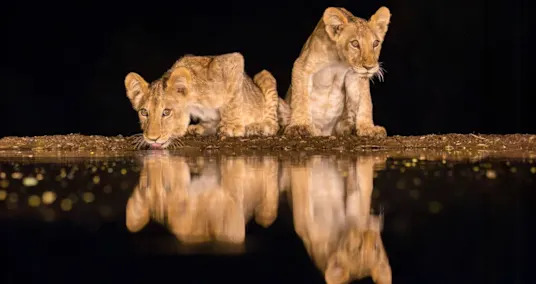
Most nocturnal animals have a reflective layer behind the retina that bounces light back toward its source, producing the characteristic eyeshine that often reveals a hidden animal. In well-run operations, a professional tracker works a high-powered spotlight from the front of the vehicle: your lens and their spotlight will frequently be pointing at the same target.
Always ask your guide before using your own flashlight. Many guides prefer there to be no additional light sources, or use filtered flashlights, to protect the experience for everyone on board and to avoid stressing the animals.
4. Work the golden windows

Drives that begin at sunset offer a real opportunity: big cats and predators wake slowly as temperatures fall, often moving to a waterhole before hunting begins. This is a transitional moment (predators sharpening their senses, marking territory, staring to move) and it can make for compelling images.
Later on, look up. With almost zero light pollution across reserves in Namibia and Botswana, the Milky Way can be bright enough to shoot without specialist equipment. Parts of Namibia hold International Dark Sky Reserve status, placing them among the finest stargazing locations on Earth.
5. Listen as hard as you look
Sound is a navigational tool: a spotted hyena's distinctive whoop, a lion's chest-shaking roar or the piercing cry of a galago can pinpoint an animal in the dark long before your lens finds it. Rustles, wing beats, hippo grunts and the rhythmic trill of a nightjar all signal nearby activity. Train your ears alongside your eyes and your reaction time will improve accordingly.
6. Choose your lodge carefully

National parks across Africa enforce strict gate times, requiring vehicles back at camp by sunset. Private concessions have no such restriction, allowing guides to stay out through the prime nocturnal hours. If night photography is central to your trip, lodge selection is arguably the single most important variable. Look for camps that invest in experienced night guides, appropriate lighting equipment, and ethical protocols around spotlighting; particularly regarding diurnal species that should not be disturbed after dark.
As Botha puts it: "Seeing lions stir as the temperature drops, or catching a civet or an African wildcat on the move, adds a layer of discovery you simply can't get during the day. When managed correctly, with deep respect for the animals, a night drive adds an incredible wow factor to your journey."
Check out our guide to the best lenses for safari photography
LATEST POSTS
- 1
 What's the new 'Knives Out' mystery about? Everything to know about 'Wake Up Dead Man,' including who's in the cast and what the reviews say.
 - 2The Universe of Impeccable Pearls: A Manual for Valuable Gems
- 3An Aide On Upgrading Your FICO rating
- 4Old food pyramid vs. RFK Jr.'s new food pyramid. See what's different.
- 5Kiefer Sutherland arrested after allegedly assaulting a ride-share driver in L.A.


- New method spots signs of Earth's primordial life in ancient rocks
- Who is Artemis? Meet the Greek goddess who inspired NASA's return to the moon
- Sean 'Diddy' Combs faces new sexual assault allegations, currently under investigation by Los Angeles Sheriff's Department
- Warming winters lead to more nitrate pollution in the drinking water near farms
- Nutrient Rich Organic products: Lift Your Wellbeing
- The most effective method to Apply Antiquated Ways of thinking in Current Brain science Practices
- COGAT discovers motor oil hidden inside UN's humanitarian aid to Gaza in smuggling attempt
- Find the Excellence of Old style Expressive dance: Encountering the Effortlessness and Polish of Dance
- IDF strikes Hamas terror base in Lebanon, Health Ministry says 11 killed