‘Courageous, creative, and deeply committed’: The Young Scientists and Developers in Israel returns for its 29th year amid war, as part of National Science Week events.
Even in these challenging times, the Young Scientists and Developers in Israel competition – now in its 29th year – has been held with the aim of discovering and promoting the future generation of Israeli scientists from among high school students. The competition was part of the National Science Week events, which always begin on Albert Einstein’s birthday on March 14.
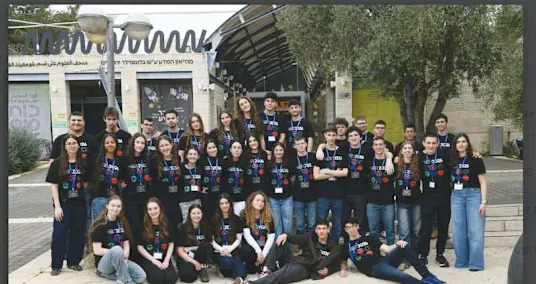
Managed by Jerusalem’s Bloomfield Science Museum, in collaboration with the Education Ministry’s Technological Education Administration and the Israel Academy of Sciences and Humanities, the competition included 53 young scientists from across the country. It was supported by the Jerusalem Municipality, Israel Aerospace Industries, the Jerusalem Foundation, and the Mandel Foundation.
The students presented 46 outstanding projects, the fruit of many months of work and research, in the fields of history and social sciences, life and environmental sciences, technology and computer sciences, mathematics, and natural sciences. Prof. Hanoch Gutfreund, a world expert on Einstein and theoretical physics who was the president at the Hebrew University of Jerusalem, was head of the judges’ panel.
Bloomfield Science Museum director Rony Ben-Chaim spoke of her satisfaction with the competition.
“I am so proud of the participants. They excel in what they have learned and done,” she told The Jerusalem Post in an interview. “They come from all over Israel, from the South to the Golan Heights. We had to delay the competition due to the war, but on judging day, most of the teens and their parents came; those who couldn’t explained their research on Zoom. But this is not new to us; during the COVID-19 pandemic, we did the same thing.

Physics, mathematics on the rise
Bar-Chaim said that this year, there were more presentations in physics and mathematics, as well as practical inventions.
“But we are worried about what will happen next year and the year after that, as missing their classes now and the pressure from matriculation exams could make the teens decide not to pursue their research,” she said. “This happened as a result of the pandemic as well.”
Unusually, the judges awarded two first prizes, three second prizes, and three third prizes, with the top ones very abstruse: Characterization of dark plasmon states in silver nano-bowties, by Liam Rokach of the De Shalit High School in Rehovot.
The other first-prize winner was Eyal Zakesh of the Municipal High School in Modi’in for his work on “The effect of different lighting conditions on the kinetics of hydrogen and oxygen production in different wild microalgae strains.”
A second prize was won by Tom Ashkenazi of the Kiryat Sharett School in Holon for Milah, a children’s game for developing pronunciation, which was meant to cope with the long waiting times for speech therapists to provide youngsters with regular treatment, especially in the periphery, where there is a shortage of professionals. The AI-based home practice tool analyzes the child’s speech and provides immediate feedback. The system uses a speech recognition model specially trained on children’s speech in Hebrew and ChatGPT to analyze errors, find their location and type, and provide an adapted response.
Yet another second prize was won by Ofir Mana of the school in Kibbutz Shoval on “Matriculation in the shadow of war: exploring the relationship between internal and external resources and academic self-efficacy that assessed academic self-efficacy – the perception of the ability to successfully complete assignments. It focused on how high school students coped with the matriculation exams during the Gaza war.

The long waiting times for speech therapists make it difficult for children to receive regular treatment, especially in the periphery, where there is a shortage of professionals. In addition, a large part of the responsibility for practicing at home falls on the parent, who is required to be present and focused during each practice, and the existing practice tools are outdated and not adapted to current technologies.
The third second prize was won by Shira Krause of Tel Aviv Municipal D High School, on “The effect of receiving prosocial behavior on brain activity in rats exposed to alcohol.”
One of the third prizes was won by Assaf Kadosh and Ido Korland of Shamir High School in Petah Tikva for “DogSense” – a smart collar that analyzes and presents a pet’s mood to the owner via a phone interface, allowing the owner to respond in a more tailored manner to the dog’s behavior. The product minimizes the use of electric training collars, helping a puppy or an adopted shelter dog to adapt to its environment, and contributing to a more efficient, safe, and humane training process.
One of the seven projects that won an “honorary mention” was “DeFOG,” a system for identifying and monitoring motion stagnation in Parkinson’s disease patients who have tremors and stagnation in movement, which exists in half of the victims around the world. Yarin Dantes of the ORT School in Kiryat Bialik devoted his project to helping patients suffering from sudden stops in place during movement or the beginning of movement that can cause falls and loss of self-confidence of the person.
Today, there is no marketed solution that can help those people who experience the phenomenon, and all solutions exist only in the laboratory. The system detects the phenomenon by transferring data from an accelerometer located in the selected place, after checking the optimal location on the frequency axis, analyzing short time windows on it, and marking stagnation. The project offers a lightweight and accessible solution that can also help doctors monitor the development of the disease in the patient.
The winners, who were awarded scholarships of NIS 10,000 to NIS 3,000 depending on who are the top winners, will represent Israel at the ISEF Global Competition in Phoenix at the European Union’s Young Scientists and Developers Competition in May, followed by a science camp hosted by the German government and another event in Switzerland.
“This year’s projects have touched on the most pressing questions of our time: from personal security and health, through artificial intelligence to space exploration. They prove that Israel’s young generation is not only curious, but also courageous, creative, and committed to improving reality,” said Ben-Chaim.
“Especially in these challenging times, the choice of young people to invest long months in in-depth and complex research is a source of hope and strength for all of us,” she added. “The projects prove that the young generation in Israel is not only curious, but also courageous, creative, and deeply committed to improving reality.”
The science museum has been open even during the war, but only 50 visitors are allowed to enter at one time because of Home Command restrictions. “Many more want to come, even though some have had to rush to our shelter during missile attacks,” the director concluded.
LATEST POSTS
- 1
 I'm 18 and founded an AI startup. I have to wake up at 3 a.m. to work on it before school, but it's worth every sleepless night.
 - 2A definitive Manual for the Over-Ear Earphones
- 3Turkey's Erdogan denounces Israel-Greece-Cyprus trilateral summit, affirms support for Gaza
- 4How to watch ‘The Traitors’ Season 4: Premiere date, episode release time, full cast list and more
- 5Slims down for Maintainable Weight reduction


- Fireball sightings are surging across the US — here's what's really going on
- 'The Beast in Me' arrives on Netflix: Is it based on a true story? And what drew Claire Danes to it? What to know about the thriller series.
- Thermo Fisher wins contracts as pharma shifts production to US, CEO says
- At least 171 measles cases confirmed in 9 states, CDC data shows
- Smooth countdown continues for Artemis II moon mission
- Hanwha Ocean secures orders worth $866m for five vessels
- Select Your Go-To Bluetooth Earphones
- Triple polar vortex to plunge central and eastern U.S. into Arctic cold through mid-December
- Find the Force of The ability to understand anyone on a deeper level: Improving Mindfulness and Connections